Categories
Mineral Water Business

Mineral Water Plant Business Plan

What Is A Business Plan ?

It’s just like a Roadmap towards achievement of certain Goals decided. A Plan might consist of several steps one needs to take in the process of achievement of that. It is just like getting to a place with a pre decided route & means.

Is This Applicable to A Mineral Water Business ?

Mineral Water Busines Plan Expert Mr Biman Gandhi
Mr Biman Gandhi , Professional Business Coach

For that matter, it’s applicable to all businesses, not just Mineral Water Business. Recently during our Mineral Water Plant Training, we requested a Professional Business Coach, Mr. Biman Gandhi to conduct a small Session on this subject to guide our participants. Post the training, we also interviewed him.

Here is the Audio Recording of the same :-

The Summarized Text Version of the Interview :-

#Business is not an easy occupation. A well-written business plan is inevitable when you intend to do a business

#Doing business is a Serious Business

#The GPS analogy and how it is useful when it comes to write down the business plan.

#Business Plan helps you to convert individual desires into a vision that is inclusive for all. A vision invariably talks not just about profit, but also the People and the Plant.

Various components of Business Plan such as

• Executive Summary, Vision, Mission and Purpose of a business.
• Financial Consideration
• Business Model, Marketing and Services
• Branding, Promotion
• Compliance, Statutory Requirements, Norms, Standards – Due diligence
• Plant and Machinery Costs, Profit Margin, Expenses
• Availability of human and non-human resources, the location of the business
No amount of planning or the best of the best plan ever give you a guarantee to be a success. But if you dive into a highly comptetitive business like a Mineral Water Business ; without business plan definitely is surety to failure.

#The growth rate of the Mineral Water Business is phenomenal in India – It is growing at a rate of 25% every year.

#A well-written business plan is a roadmap and it serves as the guide. It keeps you on track, it compels you to set the priorities, it guides to you take informed decisions and make right choices, It makes you more sincere about your objectives.

#It is advisable to take an “External Help” such as Business Coach or Consultant. Because writing the business plan is not about just fitting the content under various sections of a business template that you might grab from internet

Making a Business Plan is the 1st major step

Once you create a Business Plan, you are actually defining the What , When, How for your Ideas to come into objects. “Why” is the Vision, Mission. Not that they are not there, but a Business Plan demands that to be defined properly.

Why It is Necessary for a Mineral Water Business to have a Detailed Plan ..

The Mineral Water Business, which really started booming up in India from 2003. It is split between the 3 national brands and the others. The others are the local brands, some really are “Brands” though local and others are just some names, not brands. 

With the emergence of Totally Digitized economy, from 2016, the market actually started taking a different direction & shape. It’s not possible to operate with the “Without bill” mentality. Meanwhile, everyone is venturing into this ever growing market. Hence the competition is severe. To really survive, you need to work with a strategy. This demands all things to be put on a paper, in advance. Hence this demands a perfect Busines Plan to be in place. 

Get Your Vague Ideas Clear by Attending an Idea to Actualization Training, Decide Your Business Model. We recommend Hiring a Business Coach (Get 1st FREE Consultation from Mr Gandhi, absolutely Free). Fill Up the Form on Contact Us Page.  

Categories
Mineral Water Business Mineral Water Business Profit

Is Mineral Water Business Still Profitable in 2026? (The FSSAI “High-Risk” Reality Check)

Yes, This Business is Still Profitable in 2026 also !

Table of Contents

Defining the Product: Why “Packaged Drinking Water” is the 2026 Gold Mine

Most people use the term “Mineral Water Plant,” but technically, we are almost always talking about Packaged Drinking Water.

In 2026, understanding this distinction is the difference between a failing amateur and a profitable professional:

  • Packaged Drinking Water (The Volume Play): This is produced from any groundwater source. We use the Reverse Osmosis (RO) method to strip dissolved minerals and then scientifically re-balance them for taste and health. This is the standardized scalable model most plants in India follow.
  • Natural Mineral Water (The Niche Play): This is rare, location-specific water that is balanced at the source itself. The costs, source-water protection, and FSSAI regulations for these are entirely different from standard plants.
    Strategic Resource: If you are specifically looking to bottle water directly from a natural protected source without RO, read our deep dive here: What is Packaged Natural Mineral Water Actually?.

The 2026 Strategic Shift

While the bottling and packaging methods remain similar, the regulatory environment has changed ( From BIS to FSSAI High-Risk Category ). As an investor, you aren’t just selling “water”; you are selling Certified Safety.

Expert Insight: In 2018, having a standard RO plant was sufficient. In 2026, your profitability is strictly indexed to your FSSAI High-Risk Compliance. If your plant architecture lacks Sanitary Design principles—such as CIP (Clean-in-Place) compatibility, microbial-resistant surfaces, and automated batch-traceability—your “profit” will be liquidated by compliance penalties and high frequency of sanitation downtime.

Profitability for the Plant Owner: Why MRP is a Mirage

One of the most dangerous mistakes a new investor can make is calculating ROI based on the Maximum Retail Price (MRP). While the consumer pays Rs. 20 (or Rs. 18 post-GST adjustment) for a 1-liter bottle, that figure is mathematically irrelevant to your manufacturing profit.

To understand your real margins in 2026, you must look at the Ex-Factory Price—the price at which you sell to your distribution network.

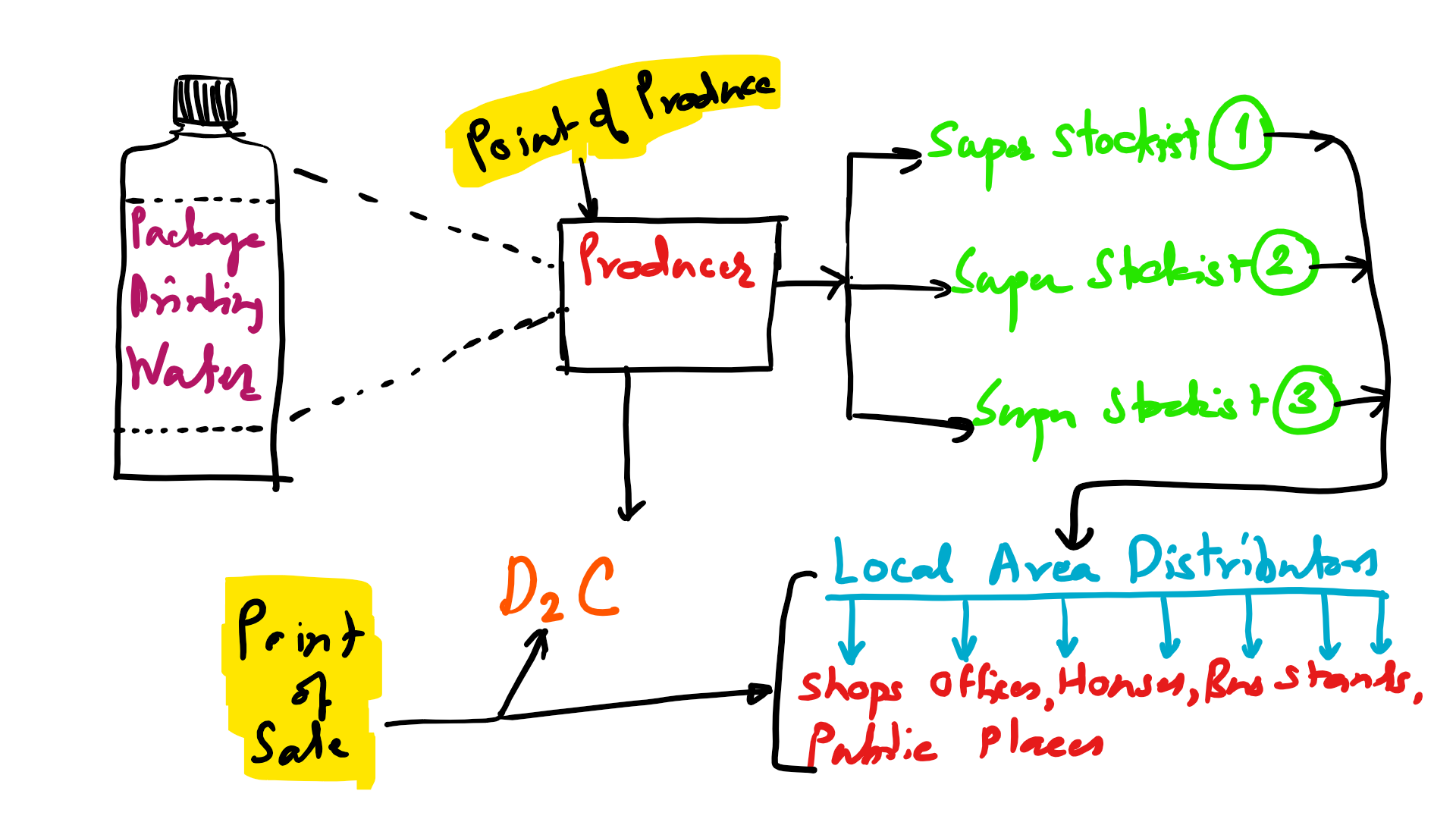
The 2026 Distribution Reality

Your profitability is distributed across a multi-tier channel:

  • Super Stockist: Usually handles an entire city; they buy at the lowest price point directly from you.
  • Distributors: Appointed by stockists to cover specific zones.
  • Retailers: The final point of sale (hotels, shops, malls) that realizes the highest margin per unit.

Technocrat Note: As a producer, you often earn the least per bottle compared to the retailer. Your profit is a function of Volume and Operational Efficiency, not the retail price tag.

Increased Capital & Operational Pressure

The 2026 landscape has shifted the financial “Breakeven Point” (BEP) due to two primary factors:

  1. Capex Inflation: To stay competitive and compliant with the “High-Risk” FSSAI mandate, plants now require higher-capacity, automated machinery to lower the per-bottle labor and utility cost.
  2. Opex Sophistication: Tight monitoring of “Money Leakages” is now mandatory. Winners in this space are implementing ERP systems and Real-time Monitoring to maintain margins while MRP remains stagnant.

High Margin Revenue Streams for 2026

Co-Packing & White Labeling: Producing for the HORECA segment ( Hotels, Restaurants & Cafes or other private brands who sell under their own name. This allows you to utilize your plant’s full capacity without the marketing overhead of a new brand.

Check the Playlist below

B2G (Business to Government): The Institutional Profit Model

While most entrepreneurs focus on the crowded retail market, the most stable profits in 2026 lie in Government Partnerships (B2G). Partnering with state entities like MSRTC allows a local plant to shift from “selling” to “supplying,” ensuring 100% machinery utilization and guaranteed monthly volumes.

Key Highlights of the B2G Segment:

  • Massive Volume: Move lakhs of bottles through established networks (Railways, Transport, Tourism) without individual marketing costs.
  • Brand Authority: Using a co-branded label (like the Nath-Jal model) grants your plant instant trust and a “Quality Shield” against local competitors.

Case Study: The Nath-Jal Blueprint Watch the video below to see how a Pune-based unit scaled through an MSRTC partnership. We cover the exact “how-to” of these institutional tie-ups in our [Advanced Training Program].

Glass Bottling: A premium, eco-friendly segment growing rapidly in the hospitality sector. This is the ultimate “Reliance-proof” model because it targets a segment that values sustainability over the lowest price.

Technical Preview ( Short )

Operational Efficiency: The 2026 Profit Multiplier

In the 2026 “High-Risk” regulatory environment, profit isn’t just about what you sell—it’s about what you don’t waste. With increased scrutiny from FSSAI, a single documentation gap or failed batch can wipe out your quarterly gains.

The “Zero-Leakage” Strategy To survive the price pressure from massive entrants like Reliance (Campa Sure) at Rs. 15 MRP, your plant must operate with surgical precision:

  • Real-Time Monitoring (IoT): Tracking electricity consumption and water rejection rates; an RO rejection higher than 30% is a direct hit to your bottom line.
  • Inventory & Batch Traceability: Automated systems for preforms and caps are now mandatory to prevent the 3–5% margin loss common in unorganized plants.
  • Labor Optimization: Transitioning from manual loading to semi-automated conveyors reduces breakage and lowers the “per-bottle” labor cost needed to compete in the current market.

Diversifying Your Revenue Streams

As discussed in the “High Margin Revenue Streams” section above, relying on a single brand or a passive distributor model is no longer a safe bet. To truly maximize the operational efficiency of your plant, you must utilize your capacity through specialized, high-margin models.

The 2026 Unit Economics: Can You Survive a ₹15 MRP?

To compete with massive entrants while maintaining a professional, “High-Risk” FSSAI-compliant facility, your unit economics must be surgical. Below is the 2026 Benchmark for a standard 1-liter bottle (19g preform) produced in a 2000 LPH plant.

The Cost-Per-Bottle Breakdown (1 Litre)

  • Raw Material & Consumables: ₹4.00 (Includes preform, cap, label, and shrink film).
  • Operational Overheads: ₹1.50 (Includes electricity, mandatory monthly lab testing, and FSMS compliance).
  • Total Cost of Manufacturing: ₹5.50 per bottle / ₹66 per case (12 bottles).

Technocrat Warning: If your current or planned plant exceeds ₹6.00 in manufacturing cost, you are at high risk of being priced out of the retail market by 2027. Success in 2026 is about Volume Efficiency and Money Monitoring.

5. The Final Verdict: Is it Still Profitable?

On the outset, the Mineral Water Business IS profitable because the demand for “Pure Water” is non-negotiable. However, in 2026, “demand” does not guarantee “profit.”

To make YOUR business profitable, you need to move beyond being a machinery operator and become a technical strategist who understands your Break-Even Point (BEP) and ROI.

The “Sincere Informer” Strategy for Success:

  • Achieve BEP within 12 months: This requires strict control over “invisible” expenses like machine downtime and water rejection.

What is a Break-Even-Point

  • Optimize the Product Mix: Do not ignore 20L Jars. They offer lower OpEx (no recurring preform costs) and direct margins that often exceed 30%.
  • Avoid “Least Price” Machinery: Choosing a supplier solely on the lowest quote is the #1 profit-drainer due to future downtime and compliance failure.

Where to Begin?

Why start by repeating the mistakes of failed entrepreneurs? Learn the Aqua-Finance Metrics from mentors with over 28 years of industrial experience.

  • Option A: Professional Training: Master the 2026 FSSAI “High-Risk” framework and learn how to innovate your distribution model.
  • Option B: Technical Consultancy: If you are ready to build, let us audit your technical specifications before you sign a machinery contract.

“Don’t build a plant based on a machinery quote. Build it based on a Profit Matrix.”

⚠️ Strategic Alert: The Death of the “Passive Producer” Model

In the previous decade, a plant owner could survive by simply appointing 5–10 distributors and focusing on production. In 2026, that model is a liability.

With the entry of conglomerates like Reliance—launching Campa Sure at a disruptive Rs. 15 MRP—the “middleman” margin is being squeezed to zero. If you rely solely on traditional distributors, you are competing on price against a giant with infinite “Economies of Scale.”

FAQs About Profitability

What is the average “Cost per Bottle” (Unit Economics) in 2026?

Basic Consideration
– standard 1 Ltr Bottle. Having 19 gms Weight
– 2000 LPH + 30 BPM Very Basic Plant
– Produces 700 Cases per Day ( BEP )
– Purchase + Consummables = Rs. 4 per Bottle
– Overheads = Rs. 1.5 per Bottle
– Cost of Mfg = Rs. 5.5/Bottle, Rs. 66 per Case
We discuss this in details in Training

How Long Does it take to achive BEP ?

Every Plant has a different BEP. The earlier you reach to the BEP the better profitability you can expect.
At the end of 1st year, you should be reaching the BEP, if you maintain a strict control over Expenses.

Which is more profitable : 20L Jars or 1L Bottles?

20-liter jars offer lower OpEx (no recurring preform and blowing costs), with net margins often exceeding 30%.
However, 1-liter bottles have a much larger market share and better brand visibility. A balanced “Product Mix” is often the most stable profitability strategy.
Word of Caution :- Many entrepreneurs totally neglect the Jar Vertical, and just talk about Bottles. Do not forget that 20 Ltr Jars offer you more “Direct” Customers, which reduce your sales expenses to a great extent & boost up your productivity.
– We have many success stories of entrepreneurs who started with just Jars, and now own a couple of factories.

What are the unknown Profit-Drainers ?

The most major of them is Machine Down Time. We have observed entrepreneurs just choose machinery from suppliers offering them Least Priced Equipment.

Categories
Raw Water Required for a Mineral Water Plant

How Much Raw Water is Required for a Bottled Water Plant in India Daily

Mineral Water vs Packaged Drinking Water

As you might be aware that Bottled Water Plants in India are either Packaged Natural Mineral Water Plants or Packaged Drinking Water Plants. These names are defined by the B.I.S. [The Bureau of Indian Standards], which is the govt body in India to monitor the quality of the Drinking Water sold in Bottles in India. There are quality standards defined by the B.I.S. and these standards are also numbered.  The Packaged Natural Mineral Water bears IS 13428 and Packaged Drinking Water bears IS 14543 as their standard numbers.In India, you find Packaged Natural Mineral Water 22 plants as on date. And the remaining (5500 +) are “Packaged Drinking Water Plants” 

The Principle Difference

In principle, the difference is in the quality of the raw water. If the raw water has the same qualities defined by the B.I.S. as the Packaged Natural Mineral Water, then it will be Packaged Natural Mineral Water IS-13428, otherwise, needs to be treated using the R.O. Technology (Reverse Osmosis) to purify the Raw Water & produce the final drinking water the Packaged Drinking Water IS-14543. During this process it rejects certain amount of water. Effectively,there is a difference between the Raw Water Extracted from ground and the Pure Water Produced. Hence, the calculation of Raw Water for Mineral Water Plant becomes a fundamentally important thing here.

Before going further, a quick explanation of the rejects

The rejects are the impurities filtered out from the plant, in form of Reject Water. The reject water can be used for gardening, sanitation etc. 

How much is the difference ?

The difference depends upon the quality of the Raw water for mineral water plant. More precisely : How much impurity the raw water contains. To know the impurity of Raw Water, it needs to get tested from a laboratory. Once the report is available, we can know how much water can be used & how much will be thrown out. The difference depends upon the Raw Water Report. (Actually you just require a simple TDS meter to know how much water you can use & how much to reject.)

Is it necessary to know this ?

Yes. It is necessary for you to understand this thoroughly. As Business Owner, it is not expected from you that you should know the operational details. You are expected to hire proper, able persons on this job. Still, you should know why you need them & the basics of Raw Water to Pure Water.

Another reason why you need to know this is : You should be able to specify the exact Water Treatment Plant Capacity for your Mineral Water Plant. Usually, these water treatment systems are specified in terms of LPH (Ltrs Per Hour). Once you are aware of how much water you are going to produce daily, it’s very easy to calculate the hourly requirement. 

Give Exact Specifications for Water Treatment Plant & Other Machines too !

Once you know your own exact requirement, you can specify to suppliers correctly and hence you are likely to get more correct quotes from suppliers from websites like Indiamart, TradeIndia, Alibaba, etc. Define your search properly, compare various suppliers & get your best offer from them. Define your filters properly & call exact suppliers, compare them.

Mineral Water Plant Suppliers selection Criteria

How to Appoint the best supplier ?

This is very relevant, but go with the experienced in the field. Usually , people don’t do proper pre research & we have observed after doing over 150 installations that those who fail, do not get proper information. We have designed our Live Training syllabus to keep your mistakes to minimum. The intro session itself starts with this. Here’s a screenshot of the session’s main topics :-

time line for Mineral Water Plant Training 1st Day

A Business Owner should be ready for all situations !

The Groundwater quantity may go down with changing seasons; hence it’s better to know & be prepared as a business owner in advance as to how much is he going to need so he can fill up the gaps between demand & supply.

It will be also useful to calculate the size, capacity of the borewell as well, if you are buying new piece of land for your project.

Types of Raw Water for a Mineral Water Plant

Water is the basic resource. One can use Borewell Water, Municipal Water for their Mineral Water Plant. The Open Well also can be used as water source, but River Water Can’t be used as Raw Water Source as per the laws from the B.I.S. (Bureau of Indian Standards and P.C.B. (Pollution Control Board)

Why River Water is Not Allowed ?

River Water can get easily contaminated , hence it is not allowed. Borewell, on the contrary is the best source as the source is well protected within the soil itself. Talking about Open Well; it should be covered well & you will need to submit reports to B.I.S. from time to time. 

Can We Use the Groundwater Directly ?

No. You have to treat the water to the desired level of purity before Bottling. For this, a separate Water Treatment Section needs to be established within your Mineral Water Plant. We shall cover this in the Mineral Water Plant and Machinery. But for water, the impurity is in form of TDS (Total Dissolved Solids). They are removed from the Raw Water and this TDS containing water is rejected. The amount of water which is useful & rejected can be calculated.

Initially you do not need a Water Test Report

Usually, the mineral water plant suppliers will demand a Water Test Report of the Raw Water before giving you the quote. In a way, they are right. Then, you typically approach to an ISI approved lab or a local water testing lab with your raw water sample, which offers you a detailed Water Test Report, with all BIS specified parameters. No problem if you get that, but at this stage, when you have not even decided anything, it’s pointless to get this detailed report. At this stage, you require mainly 2 things :-

  1. How Much Raw Water Is Available to You
  2. How Much Pure Water You can get from the Raw Water

If you know just these 2 things, you can design your whole plant. Otherwise, if you go to any BIS approved lab, you will end up spending a huge amount, which is not needed at this moment. And even if you do this, you will again need to carry out tests once you are through with your finance & Green signal from all authorities, it is a BIS necessary thing. Just look at the following image to know how much the BIS approved labs charge for the tests.

Rates by ISI Approved Labs for Packaged Drinking Water

As discussed, you don’t need this. You can arrive at your desired results in just 10-15% cost of the above charges mentioned. During our Training or in the Home Study Course, we train you on this aspect. 

Get Your Water Sample Ready

If you have your Raw Water Source ready; just take out 1 Ltr from that & test it. Alternatively, if you want some better accurate results,t here are plenty of Testing labs located everywhere, but it is better to get it tested from a Water Treatment specialist. We too offer this service , in which we get the water tested & we also suggest you the treatment for the same. Please contact us if you are looking for the same.

Water is also a cost for your plant. Now, it’s going to be chargeable. Tomorrow surely, if not now. We do consider it as a cost component. And there are certain other cost components too, besides this. You can read a detailed post about the various Mineral Water Plant Cost Components in this article.

Designing Mineral Water PlantIf you attend our Live Training or buy the Home Study Course, you can also do it yourself (Calculation of all relevant costs); we teach you a secret simple method by which you can also know the Quality of the Raw Water as well as whether the Quantity available is sufficient or not.


We have trained over 1000 Aspiring entrepreneurs from 2015. Many of our students are finding our training very useful. You can check reviews from our attendees. 

Categories
Land for Mineral Water Plant Resources Required

How Much Land Required for a Mineral Water Plant

Updated April 2026 | Soumitra Ghotikar

When someone takes a decision to start a Mineral Water Plant, the first thing he looks for is Land which will consist of an adequate Water Source Available. You may be having big land or might be having just a piece of land with you. Still, it is necessary for you to know exactly how much Land will be required for your Mineral Water Plant.

Why Land Comes First before All…

💡 28-Year Reality Check: Progress vs. Motion

“Most entrepreneurs confuse construction with progress. In 28 years, I’ve seen hundreds of ‘randomly built’ sheds that never became successful businesses. If you build a shed based on local contractor advice before finalizing your machinery layout, you aren’t building a factory—you’re building a future penalty from the FSSAI. In a High-Risk category, the process must design the building.

Most aspiring entrepreneurs make major mistake of treating land and factory construction as an afterthought to machinery. They gather fragmented information, rush into construction, and attempt to “fit” a professional operation into a random shed.

The result? A “poor factory” that inevitably leads to a “poor business.”

After 28+ years of observing successful and failed ventures in the bottled water industry, the pattern is clear: your machinery must serve your layout, not the other way around. Proper land assessment—considering hydrogeology, logistical flow, and regulatory spacing—is your first line of defense against operational bottlenecks and licensing failures.

Don’t build a monument to inefficiency. Establish your land and layout requirements first to ensure your infrastructure can actually support the technology you plan to install.


A professional water plant footprint consists of two essential components :

Covered Area

The Covered area is the Shed in which the actual production takes place

Open Area

The open area is for the utilities, parking space, the lawn, beautification, scrapyard and other things.


How much should be the Shed Size ?

This purely depends upon the machinery you have decided to house in. This depends upon the Production Capacity of the plant. Once you have your capacity properly calculated ; you can decide the machinery matching that capacity. The Machinery suppliers supply you the dimensions. Then you need to draw a proper layout of the plant to get the exact Shed Size required for your Mineral Water Plant. 

⚠️ Critical Warning: The “Casual Approach” Trap

Most entrepreneurs treat a water plant like a generic warehouse or a mechanical workshop. They think they will observe a few Water Plants ( Online/Offline ), and build the Shed on their own. If one builds on the basis of seeing existing units, This is a million-rupee mistake.

FeatureThe “Casual”The “Pro”
LogicBuild a shed, then fit machinesMap the process, then build factory, then fit machines in a designed layout
Source of AdviceTurn-Key Suppliers, Local Experts, Friends from similar industry Technical Consultant / Mentor with Foresight & Industry knowledge
Approach about CompliancesLets complete factory fast, compliance can be done laterConsidering the FSSAI High-Risk hygiene zones first, though may take time initially
CostCheaper Initially, but will attract accidental ambiguities & charges consistentlyWill require initial cost commitment more, however, secures your future for hassle free operations

In 2026, bottled water is a “High-Risk” food category. Kindly understand,that though the entry barriers are lesser, compliance barriers are heavy. And one needs to take ultimate care while building a Packaged Drinking Water Factory now.

The Correct Process is 👇

Diagram showing the methodical approach to building a water factory: From production capacity and correct dimensions to hygiene zones and covered space

From Diagram to Blueprint: Why It’s Not as Simple as It Looks

While the flowchart above looks like a straight line; I must give you a stark warning from my 28+ years of field experience: Simple may not Easy.

This process is a series of critical engineering calculations, and most entrepreneurs underestimate the sheer methodical discipline required to move from Step 1 to Step 4 without making an expensive mistake.

The Requirements for Success:

To navigate this flow correctly, you must replace “Guesswork” with “Structure”:

  • Slow Thinking: This is not a race. Every decision in Step 2 affects your 20-year operational cost. You must take a methodical approach, not a rush. Slow helps you go deeper, and that’s what is required at this pointin your project.
  • A Sound Belief in Progression: You cannot skip a step. You absolutely cannot jump to Step 4 (Constructing Covered Space) until Step 3 (Leaving Spaces For Hygiene) is scientifically calculated. The building must serve the process.
  • Reliance on Wisdom: The “Why waste money on consultants” approach is the #1 cause of plant failure. It’s not a saving; it’s a hidden cost. Any AI interface like Chat GPT or Gemini can supply you information, but consultants gove you Wisdom.

The layout you choose today determines whether you pass your FSSAI audit or face heavy penalties. Even when applying for a License or Registration1, you require to upload a layout2, which will be properly inspected by an FSO ( Food Safely Officer ).

  • The Compliance Gap: Local contractors don’t understand food-grade “Flow Logic” required for high-risk zones.
  • The Penalty Risk: Operating in a non-hygienic layout can lead to immediate plant suspension and hefty fines.
  • The Success Pivot: 90% of plant failures start with a poorly planned shed—not a bad machine.

The Final Verdict: Defining Your Actual Land Footprint

Many entrepreneurs confuse “the land I own” with “the land the business requires.” To build a sustainable plant, you must be surgically precise about your project’s physical boundaries. Here are the non-negotiables:

  • The Total Footprint Equation: Your actual land requirement is the non-negotiable sum: [Final Process Shed Area] + [Operational Open Area]. One cannot function without the other.
  • Demarcate Your Boundaries: You might own a massive plot, but you must clearly demark the exact outer borders for the water plant. This defined zone is what auditors and planners will evaluate.
  • The “Future-Proof” Buffer: You must leave extra space in the open area now. Unlike machinery, you cannot “upgrade” your land size once the factory walls are up. Planning for future expansion today prevents a business dead-end tomorrow.
  • The Negative Criteria: There are strict regulatory rules regarding where a water plant cannot be located (proximity to sewage, chemical units,and also groundwater over-exploited areas3 etc.). Ignoring these “No-Go Zones” can lead to your license being rejected before you even start.
  • The Water Source Validation: Your land is only as good as its aquifer. You must validate if your water source is sufficient not just for today’s capacity, but for your future growth projections.

Moving from Information to Execution

Determining “How Much Land” is not a guessing game—it is a calculation of logistics, hydrology, and FSSAI compliance. If you get this wrong, no amount of high-end machinery can save the business.

Don’t lay the first brick based on “casual” advice.

To get the exact dimensions, financial metrics, and a structured roadmap for your specific project, I invite you to attend our Packaged Drinking Water Business Training. We move beyond blog posts and dive into the methodical, step-by-step engineering of your future venture.


Footnotes

  1. Now upto 1.5 CR annual sales turnover, you just need regis*tration ↩︎
  2. How to Upload Plant Layout on FSSAI Porta ↩︎
  3. Check Groundwater Overexploited areas ↩︎

How much minimum land is required to start a mineral water plant in 2026?

To set up a standard 2000 LPH (Liters Per Hour) plant for 20-liter jars and PET bottles, a total plot area of 3,000 to 5,000 square feet is recommended. This accounts for a covered shed area of approximately 1,500–2,500 square feet and additional open space for utilities, parking, and raw material storage.

Can I set up a water bottling plant on agricultural land?

No, you cannot operate a commercial mineral water plant on agricultural land. You must first obtain Non-Agricultural (NA) permission or Industrial conversion for the specific portion of the land where the shed will be constructed. Operating without this conversion can lead to legal complications during FSSAI or local authority inspections.

What is the difference between “Covered Area” and “Open Plot Area”?

The Covered Area is the built-up shed where actual production, filling, and laboratory testing happen. The Open Plot Area includes the space for the borewell, water storage tanks, delivery vehicle parking, and scrap yard. Total land requirement is the sum of both to ensure smooth logistical movement.

Does the new 2026 FSSAI “High-Risk” framework change the layout requirements?

Not really. While the BIS license is now voluntary, the 2026 FSSAI hygiene mandates follows same BIS standard. Just see that your layout ensures a one-way flow of material to prevent cross-contamination, which may require more thoughtful space planning than earler design/s.

Can I start a mineral water plant in a G+1 (multi-story) building?

Yes, it is possible to set up a plant in a G+1 structure if space is limited. However, this requires a very specialized technical layout to manage the weight of water tanks and the movement of heavy machinery. Proper piping and drainage planning are critical in multi-story setups to avoid structural damage.

Why shouldn’t I build the shed before finalizing the machinery layout?

Building the shed first often leads to “Permanent Waste.” If the pillars are in the wrong place or the roof height is too low for your specific blow molding machine, you will face expensive reconstruction costs. Always finalize your Machinery Footprint and service zones before pouring concrete.

Categories
Mineral Water Business Profit

5 Strategic Steps to Evaluate Mineral Water Plant Profitability

Updated April 2026

Beyond the “Cost per Bottle” Myth

Many investors fall into the trap of calculating profit based solely on direct material costs. This surface-level view is why many units struggle. To understand true profitability, you must analyze the intersection of Operational Expenses (OPEX) and Market Dynamics.

The Key Difference: Profit margin isn’t just a number; it’s a result of five specific variables you must align before you start production.

Table of Contents

Why Identical Plants Yield Different Profits

To understand why generalizations fail, let’s compare two entrepreneurs, Ramesh and Suresh, both operating plants with the same machinery but different market strategies.

The Head-to-Head Comparison (Daily Sales)

MetricRamesh
Volume
Focus
Suresh
Value
Focus
1 Ltr Cases Sold800 Cases (12 bottles /case)500 Cases (12 bottles /case)
Selling Price (to Dist.)Rs. 80 / CaseRs. 90 / Case
20 Ltr Jars Sold200 Jars500 Jars
Selling Price (to Dist.)Rs. 40 / JarRs. 30 / Jar
Total Daily RevenueRs. 72,000Rs. 60,000

Critical Observations:

While Ramesh has a higher daily turnover (Rs. 72,000), his profit margin may actually be lower than Suresh’s. Why?

  • Higher Direct & Recurring Costs: Because Ramesh sells 800 cases of small bottles daily, his direct material cost (PET preforms, labels, caps) is massive. These bottles are “use-and-throw,” meaning he must repurchase raw materials every single day to stay in business.
  • The “Returnable” Advantage: Suresh sells fewer small bottles and focuses on 20 Ltr Jars. Unlike bottles, jars are returnable assets. Once the initial investment in the jar is made, the primary recurring expenses are simply the filling labor and the cap.
  • Interest & Working Capital: Ramesh requires a much larger “Working Capital” to keep buying thousands of preforms and labels. This often leads to higher interest expenses on credit lines or loans. Suresh, by using returnable jars, keeps his daily cash outflow lower and his interest burden manageable.
  • Market Sensitivity: If the price of PET resin goes up, Ramesh’s profit could vanish overnight. Suresh is protected from this because his “packaging” (the jar) is already sitting in his warehouse or with the customer.

Strategic “Balancing” Act :-

The Ramesh vs. Suresh example isn’t about choosing one over the other; it’s about Strategic SKU Planning. A successful plant owner must be flexible enough to tweak their product mix as market demands shift.

1. Small Bottles (The “Scale” Driver)

  • Purpose: These build your Brand Identity. When people see your 200ml or 1L bottles at events or in retail shops, they recognize your name.
  • Trade-off: High recurring costs and higher competition, but essential for market “presence.”

2. 20 Ltr Jars (The “Cash Flow” Driver)

  • Purpose: Ideal for Institutional Sales (Offices, Banks, Hospitals).
  • The Advantage: Beyond the lower material cost of returnable jars, your Client Servicing Cost is significantly lower. Delivering 50 jars to one corporate office is far more efficient than distributing 1,000 individual bottles to 50 different small retailers.

Expert Recommendation: Do not put all your eggs in one basket. Use small bottles to gain “Brand Scale” and 20 Ltr Jars to secure steady, low-overhead “Institutional Revenue.” Your profitability depends on how well you balance this portfolio.

The 5-Step Strategic Framework

Calculating profitability is not a one-time event; it is a continuous process of aligning your operational capacity with market reality. Based on my experience setting up and auditing plants across India and internationally, I have identified five critical pillars.

If you skip even one of these steps, you aren’t running a business—you are gambling with your capital.

Here are the 5 Strategic Steps you must evaluate to arrive at a realistic profit margin:

Step 1: Know Your Business Model (The “Vehicle”)

Before purchasing machinery or making any investment/s, you must decide on your operational structure.When we say “Vehicle”; it points to which are the major revenue streams which bring in the Oxygen-Cash.

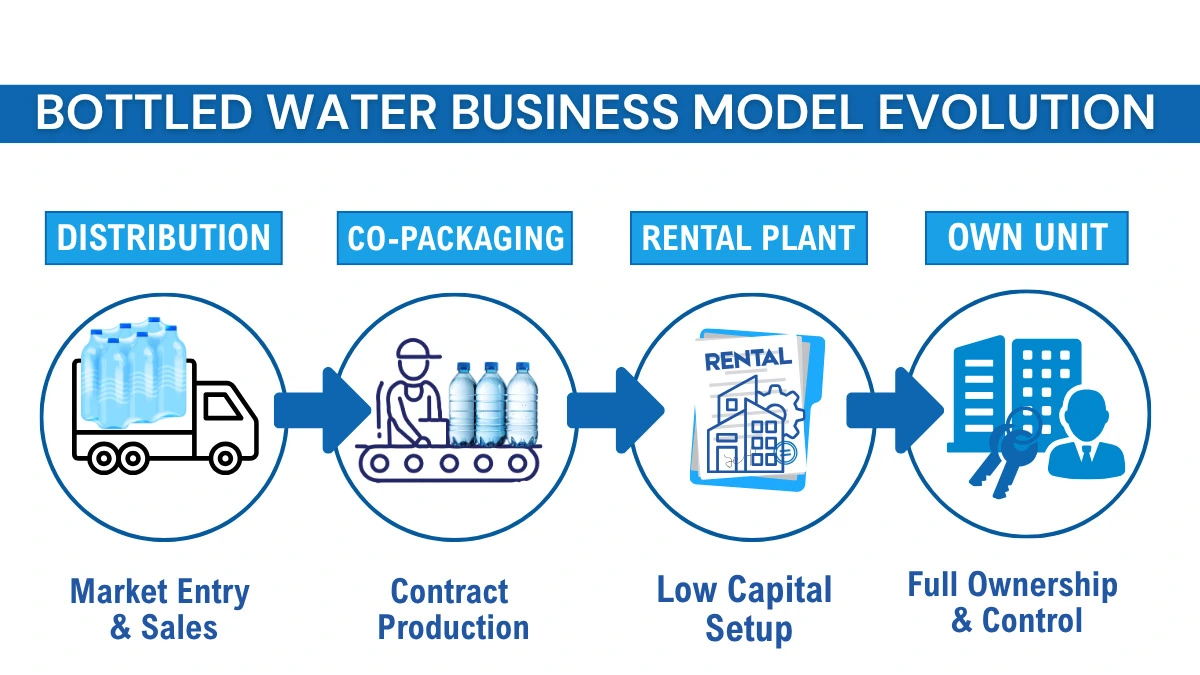
  • Own Brand + Own Plant : High reward, but requires a robust sales team and brand-building budget in addition to the Capital Investment towards resources like Land,Building,Equipments etc. Asset Heavy Business Model.
  • Own Brand + Other’s Plant (Co-Packing) : Can be started with a fairly low Capital. Asset Lite Business Model
  • Franchise Model: You leverage an existing brand’s reputation. This reduces marketing effort but involves ongoing royalty fees. This is also an Asset Heavy Business Model.

Step 2: Market Mapping & Regional Pricing

Water is a heavy, “low-value, high-volume” commodity. Your profitability is physically limited by your geography:

  • The 100km Rule: If your primary market is too far from your plant, transport and fuel costs will bleed your margins dry.
  • Price Ceilings: You must map the local “Retail Ceiling.” If your competitors are selling 20L jars at Rs. 30, your “efficient” plant won’t survive if your cost-to-serve is Rs. 28. Cost to Serve is different from COGS.

In our Training, we give emphasis on understanding the “Costing” part in reasonably high details. As most of the failures we have seen is not understanding the Numbers. Somehow entrepreneurs are shy about it. But if you master this, we assure you are 99.99% successful.

Step 3: Define Your Product Mix & SKUs

As we saw in the Ramesh vs. Suresh comparison, your SKU (Stock Keeping Unit) selection is your biggest profit lever.

  • Strategic Balancing: You must decide the ratio of small bottles (for Brand Scale) to 20 Ltr Jars (for Institutional Cash Flow).
  • Flexibility: A profitable plant is one that can quickly shift production from 1L bottles to 200ml variety or 5L jars as seasonal demand or event requirements change. And can also incorporate the 2026 new trend for HORECA : Glass Bottle Line. Flexibility also calls for expanding through new segments as well as new business models like Franchising, B2G etc. We have already explained this in our another post which talks about whether the Packaged Drinking Water Business is still profitable

Step 4: Define Your Total Cost Structure (Direct vs. Indirect)

A common mistake in the mineral water industry is thinking that “Plant Cost” is just the price of the machinery. In reality, the machinery is only the starting point. To evaluate your profit, you must separate your costs into two distinct buckets:

  • Direct (Variable) Costs: These are the costs that move with every bottle produced—PET preforms, labels, caps, consummables, electricity for production, and contract labour (if any) for packing. If you don’t produce, you don’t pay these.
  • Indirect (Fixed) Costs: These are the “silent” profit killers. They stay the same whether you sell 1 bottle or 10,000. This includes FSSAI and BIS compliance costs, factory rent, insurance, administrative salaries, and, most importantly, interest on your capital investment.

Strategic Insight: Your real profit margin is only revealed after these indirect costs are “absorbed” by your sales volume. This is why a plant running at 30% capacity often operates at a loss, even if the “cost per bottle” seems low.

Step 5: Create 3-Year Time-Bound Financial Projections

Profitability in the water business is not a sprint; it’s a marathon. You cannot judge the success of your plant based on the first three months of operation.

  • The 3-Year Horizon: You must create a financial roadmap that accounts for the “Seasonality Factor.” In India, the summer months (March–June) provide peak profits, while the monsoon and winter months see a dip.
  • The Breakeven Point: Your projections must clearly show when the “accumulated profit” will finally cover your initial investment (ROI).
  • Weighted Averages: Instead of looking at a “good month,” calculate your Annual Weighted Average Profit. This gives you a realistic picture of your business’s health across all 12 months.

Conclusion: The High Cost of Poor Planning

Calculating a profit margin is far more than a mathematical exercise—it is a strategic necessity. Industry data suggests that nearly 50% of mineral water units close down within their first few years. In my experience, these failures are rarely due to a lack of demand or intense competition.

They fail because the owners started with a “wrong calculation basis.” They chased volume instead of value, ignored indirect costs, or failed to balance their SKU portfolio.

Take a conscious, data-driven decision before you invest your hard-earned capital.

Need Professional Financial Clarity?

If you want to move beyond “rough estimates” and see the actual numbers for your specific location and business model, join our next Live Online Training. We dedicate specialized sessions to CAPEX & OPEX modeling, helping you build a plant that isn’t just operational, but sustainably profitable.

FAQ’s

Why is a high daily turnover not always a guarantee of high profit?

As shown in the comparison between “Ramesh” (volume-focused) and “Suresh” (value-focused), a high turnover often comes from selling small bottles. These require high recurring costs for PET preforms, labels, and caps. A business with lower turnover but a focus on returnable 20-liter jars can actually have a higher profit margin because the packaging is a reusable asset rather than a daily expense.

What is the “100km Rule” in the mineral water business?

Water is a heavy, low-value commodity, meaning transportation costs can quickly consume your margins. The “100km Rule” suggests that your primary market should ideally be within a 100km radius of your plant. Beyond this distance, the cost of fuel and vehicle maintenance often makes the business unsustainable unless you have a premium pricing strategy.

How does the product mix (SKUs) affect my working capital?

Your choice of SKUs (Stock Keeping Units) directly impacts your cash flow.
Small Bottles: Build brand identity but require large amounts of working capital to constantly repurchase raw materials (bottles/caps).
20 Liter Jars: Act as “Cash Flow Drivers.” Since they are returnable, your primary recurring costs are just the water treatment, labor, and the cap, which keeps your daily cash outflow much lower.

What is the difference between Direct and Indirect costs in a water plant?

To calculate true profit, you must distinguish between:
Direct (Variable) Costs: Costs that change based on production volume, such as preforms, chemicals, electricity for machines, and labels.
Indirect (Fixed) Costs: “Silent profit killers” that you pay regardless of sales volume. These include FSSAI/BIS compliance fees, factory rent, administrative salaries, and interest on bank loans. A plant is only truly profitable after these indirect costs are fully covered by sales.

Why should I create a 3-year financial projection instead of a monthly one?

The mineral water business is highly seasonal. In regions like India, demand peaks during the summer (March–June) and dips during the monsoon and winter. A 3-year projection allows you to calculate an Annual Weighted Average Profit, accounting for these fluctuations and helping you identify the exact “Breakeven Point” where your accumulated profits finally cover your initial capital investment.