
Created July 2026
Most businesses shut down because they run out of working capital. Mineral water plants face the exact same risk.
Steps to Arrive at Working Capital Required for a Mineral Water Business
Assuming it is a Production Unit, the amount of the working capital depends upon the Plant Capacity1.
Time needed: 5 minutes
Note The Steps
- Check your stock
Add up your inventory, unpaid invoices (debtors), and supplier bills (creditors).
- Remove old dues
Exclude any invoices over 90 days old. Banks ignore them.
- Calculate stock value
Banks fund up to 75% of your inventory value.
- Calculate debtor value
Banks fund up to 60% of valid unpaid invoices.
- Add it together
Sum these amounts to get your total drawing limit.
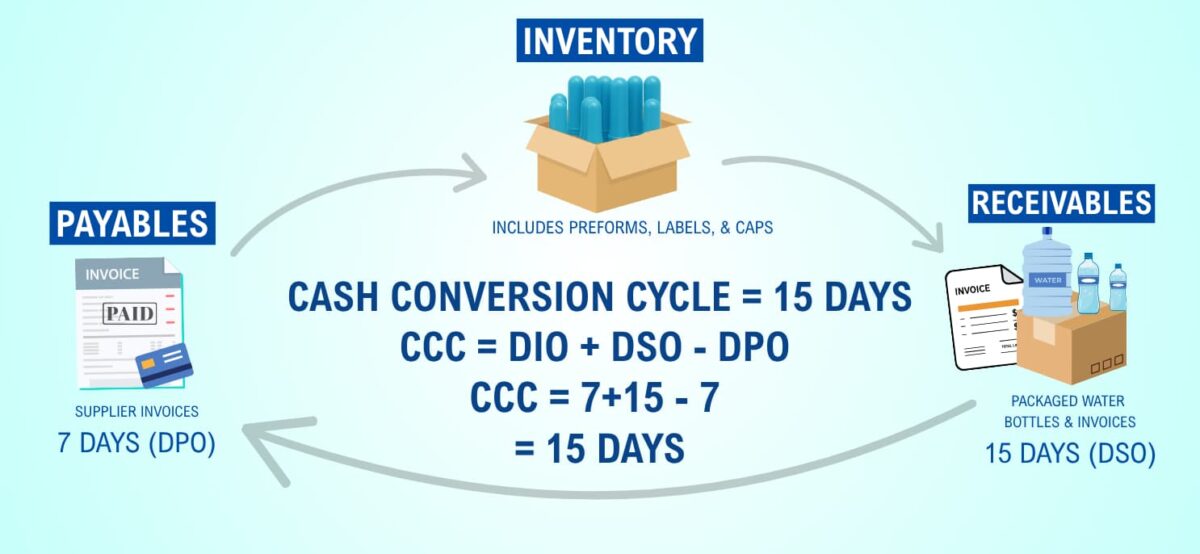
Banker’s Insight: The Role of Cash Conversion Cycle (CCC)
When sanctioning working capital, bankers look beyond stock values—they scrutinize your Cash Conversion Cycle (CCC). CCC measures the exact number of days your cash remains locked between buying raw materials (preforms, caps, labels) and receiving payments from distributors. A shorter CCC proves operational efficiency, signaling lower default risk to the bank. Conversely, a stretched cash cycle often prompts bankers to reduce your actual loan disbursement or restrict your drawing limits to prevent over-leveraging. Optimizing your CCC not only lowers bank interest costs but also helps secure full funding approval.
Importance of Working Capital
Working capital is your daily cash flow. It covers the gap between paying suppliers and getting paid by customers.
Good cash flow keeps your plant running smoothly. You can pay rent, bills, and salaries on time without taking high-interest loans. It protects your market reputation and helps your business grow.
Simple Tricks to Optimize Working Capital
- Sell stock faster: Reduce the number of days stock sits in your warehouse.
- Collect payments quickly: Collect money from buyers on time to unlock your bank limit.
- Ask for supplier credit: Getting 15–30 days credit gives you interest-free funds.
Do not delay vendor payments too long. Paying on time builds trust and a strong company culture. Some successful companies even pay suppliers early to earn better trust and discounts.
Beware :- There is interest on Working Capital
Working capital is not free. Banks charge interest on these funds. A long cash cycle helps the bank, not you. The longer it takes to convert stock to cash, the more interest you pay. Managing cash well keeps your costs low and profits high.
It Needs Regular Monitoring
It is smart to check your working capital every week. Doing this gives you time to tweak your daily operations on time
Check the “Mentoring” Service Option on our Consultancy Page
This Hindi Video Explains in Details
Footnotes
- Plant Capacity is measured in Bottles per day it produces ↩︎
FAQs
Working capital depends directly on your plant’s daily production capacity (bottles per day), raw material inventory, and customer credit terms. Typically, banks evaluate gross working capital by offering a drawing limit of around 75% against inventory stock and 60% against eligible debtors (under 90 days).
Banks calculate drawing power by aggregating your eligible assets. First, deduct ineligible debtors (invoices unpaid for over 90 days) and creditors from your total stock value. Then, banks typically allow drawing limits of 75% on net stock value and 60% on eligible debtors.
You can lower interest costs by shortening your Cash Conversion Cycle (CCC). Reduce inventory holding days, enforce timely collections from buyers, and negotiate reasonable credit terms with suppliers to minimize reliance on high-interest bank overdrafts.