Updated June 2026
The “Macro” Level Thinking
Once an entrepreneur makes his decision to enter into this Bottled Water Business, he typically starts with the “Internet-Visiting-Funding-Launching” process. Nowadays, the DIY1 methods with all those AI tools around.
However, in this post I shall more talk on the natural process of emergence. How we should look at those thoughts running inside our minds, and without giving sole authority to the AI tools, to literally drag you to a completely wrong decision.
Table of Contents
- The “Macro” Level Thinking
- 5 Main Phases
- How Can We be Useful
- Our Offerings
- Be in Touch
- Footnotes
- FAQ’s
5 Main Phases
We have split your Bottled Water dream project into 5 main phases :- Right from the moment, you have decided ( after much contemplation ) that you will be entering into this business ( not necessarily the manufacturing one 2 ) to finally running it for profits. Let’s have a look at them, Phase by Phase :-
Phase 1 : Product Knowledge
Knowing more about the exact category, regulators, detailed reference materials, prohibitions etc relating to the type of product you have thought in mind.
For example; if you are inspired by the super clean water stream, which flows 24*7*365 for years at your native, you should think of its standards, licenses, commercialization norms in India/abroad.
Phase 2 : Resources Required
Besides the Water as a resource, you require Land, Building, Electricity, Manpower, Money and many other things to start. You have a to make a list of what is available with you & how you will be going to source the others.
Phase 3 : Business Model & Finance.
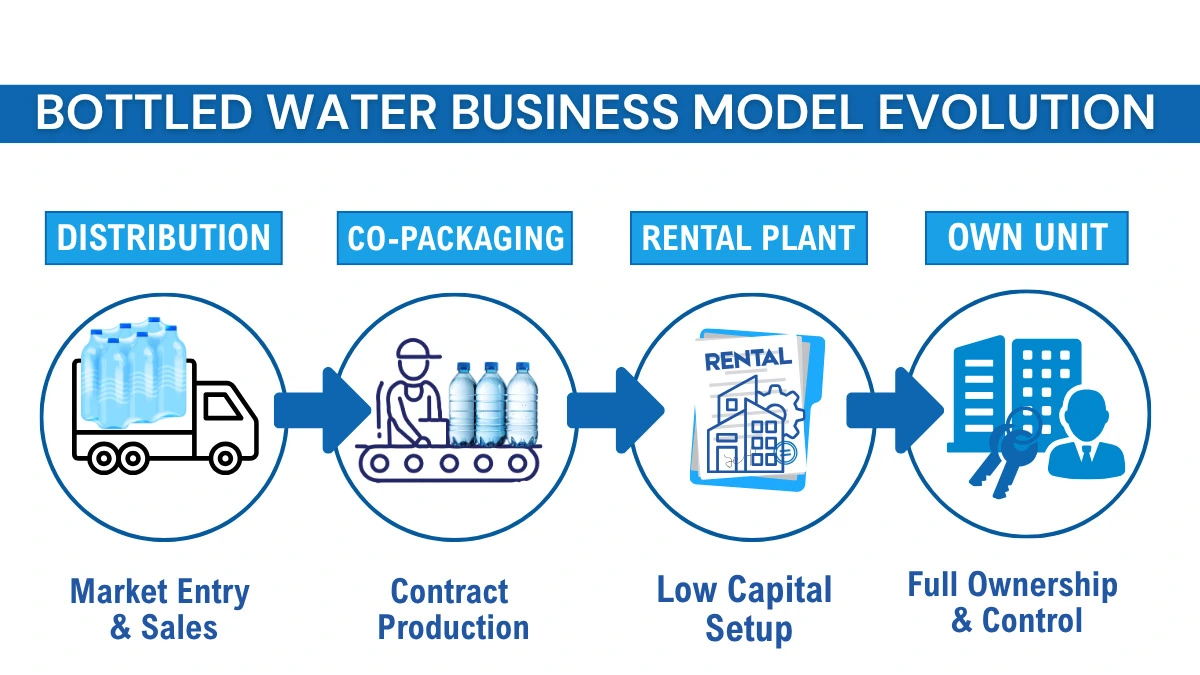
After looking at your resources & your own priorities, you might decide like Whether to make or buy. In the bottled water language, whether own plant or co-packing. According to that you will draw projections & that decides your ROCE3
Phase 4 : Capital Allocation
Now, this is the funding phase, you are making definite moves towards establishment of your Bottled Water Business. You should know the Capex & Opex4 exactly. This also helps you to calculate your B.E.P. ( Break-Even-Point ), which tells you what steps you need to follow for getting the stuff sold
Phase 5 : Vendors
Very crucial stage. As you are expected to be ready with all clearances from Bank for Funding; you need those right set of agencies. They need not be chosen only on the basis of their prices; but on the basis of their technical capacity to solve complex operational issues.
How Can We be Useful
Our own business model contains our working with the Entrepreneurs & various agencies. Our Revenue doesn’t come through Hidden Comissions from agency or Suppliers. We charge fees to clients & then they pay us.
How will this benefit you ?
Our 100% attention is focused on client. Undivided. We have our commitment towards them. This makes your job easier. Of course, when we jointly choose vendors; they may not be necessarily be the cheapest in terms of pricing, but assured : They will be the most capable to offer you an uninterrupted consistently run Bottled Water Plant
Our Offerings
- Mentoring : Continuous Hand-Holding Service
- Assesment : For Idea, Profit, Marketing,. It’s 1 Time Basis
- Trainings : Recorded & Live at Pune on 1-1 Basis
- On-Site Services : Existing Plant Sustainability, Old Plant Inspection
Be in Touch
For Anything from the list above you can be in touch through :-
- Check Contact Us Page
- Comment on this Post
- Join Whatsapp Community : 9822478111
- Join Newsletter : https://100mitras.substack.com/
Footnotes
- Wrong Way of the DIY ↩︎
- You can be just a distributor at the beginning ↩︎
- Return on Capital Employed ↩︎
- Capital & Operational Expenses ↩︎
FAQ’s
Phase 1: Product standards and licenses.
Phase 2: Resources (Water, land, electricity, manpower).
Phase 3: Business model and profitability.
Phase 4: Finance (Capex, Opex, Break-even point).
Phase 5: Choosing the right machinery vendors.
No. You can start by outsourcing production to an existing plant (co-packing) or working as a distributor.
Before making financial moves, the article highlights three crucial metrics:
Capex & Opex: Distinguishing between one-time setting-up costs and ongoing daily operational expenses.
ROCE (Return on Capital Employed): To check the efficiency and profitability of your total investments.
B.E.P. (Break-Even Point): To understand the minimum sales volume required to cover your expenditures.
Vendors should not be chosen purely based on the cheapest price. The guide strongly advises prioritizing agencies with the proven technical capacity to resolve complex operational issues, ensuring that your plant runs consistently without unexpected interruptions.
Consultants (such as the author of the article, Soumitra Ghotikar) offer varying packages including:
Mentoring: Continuous hand-holding through the production journey.
Assessment: One-time feasibility checks for your idea, profit projections, and marketing strategy.
Trainings: Recorded or 1-on-1 live training sessions (hosted in Pune).
On-Site Services: Inspection of older facilities and optimization for existing plant sustainability.