
Date Written : 15th September 2026
The Mineral Water Supply Chain: From Plant to Retail
Here is how the Mineral Water reaches to the consumers from Factory :-
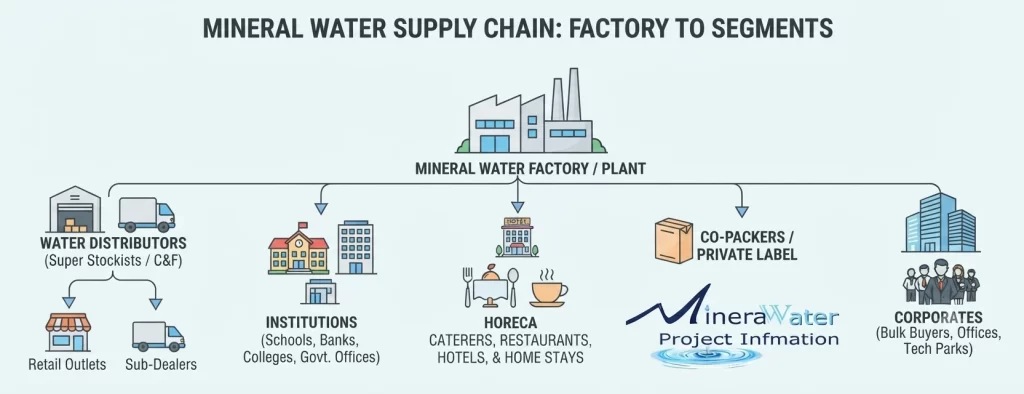
Various Segments explained
- Water Distributors and Super Stockists :- The backbone of high-volume market penetration. Independent distributors manage localized warehousing, fleet logistics, and bulk inventory management. They bridge the gap between large-scale production plants and fragmented retail networks, ensuring consistent shelf-space availability.
- Institutional Channels :- High-frequency, steady-volume accounts that require structured supply agreements. This segment includes: Educational Institutions, Banking and Financial Hubs, Government & Public Infrastructure.
- The HORECA Segment (Hotels, Restaurants, Cafes & Home Stays) :- A high-margin, brand-conscious segment that prioritizes service reliability and premium packaging presentation (such as specialized glass or sleek PET formats) over base commodity pricing.
- Co-Packers and Private Label Partners :- For manufacturers, this can be an excellent segment to cater to. These are the people who want to work with smaller capital, but you can get your capacity utilized for an elevated time-usage.
- Corporate Direct Accounts :-Bulk buyers spanning tech parks, manufacturing units, and event management entities that require scheduled, recurring deliveries of multi-litre jars or customized corporate-branded bottles.
Direct-to-Consumer Marketing
Big brands like Bisleri are already implementing direct-to-consumer strategies. However, they still heavily practice traditional distributor marketing alongside it. Hence, you should always keep in mind that distribution marketing should never be omitted from your core strategies.
When you are starting your business with limited capital, working with established distributors will give you the most freedom and time to focus on the operational stability of your plant. Therefore, start your journey there, and after 3 to 4 years of market presence, you can actively think about introducing a dedicated D2C channel, especially for your small-bottle SKUs (500ml and 1L).
20 Ltr Bottles: A Completely Different Strategy
When scaling 20-liter jars, the playbook changes entirely. For bulk jars, you will manage a hybrid model utilizing both direct and indirect channels simultaneously to keep delivery routes dense and profitable.
Whatever you choose, ultimately it alters your Financial Position. So very first, have a detailed look at this post where we have listed down the Components of Cost.
The Co-Packer Dilemma: What If You Don’t Have a Distributor Network?
f you are operating from the other side of the spectrum—acting as a Co-Packer getting production done through a third-party manufacturer—the traditional multi-tier distributor network is usually unavailable or closed to you.
The Challenge: How do you move volume without traditional distributors?
The Solution: Co-packers must target unique B2B audiences that large manufacturers cannot service efficiently. This includes specialized accounts like cafes, boutique hotels, car showrooms, builders, and banquet halls.
The Risk & Defense: A co-packer always faces the risk of losing an end customer that they built through intense personal effort. To protect your business, you must create unique value-adds—such as custom-branded labels, exceptional delivery reliability, or flexible order quantities. Here’s where Mentoring plays a special role :- Brainstorming for Developing better Value Delivering Models
Typical FAQs
A: No, if you are a small or medium enterprise (SME) starting out, a dedicated sales team is usually unnecessary. Instead, your initial focus should be on building a reliable network of core distributors.
You can manage this efficiently by utilizing your existing staff—such as your accounts-cum-office assistant and operational team—to service and support these distributors. Train them to treat every client and distributor as a top priority. Additionally, ensure your delivery drivers and loaders are trained to maintain good customer relations on the ground. By following this approach and prioritizing strong service, you can scale sustainably without the high overhead of a formal sales team until you reach a higher volume threshold.
A: Finding the right distributors requires a mix of on-ground groundwork and official database checks. You can identify and onboard potential distributors using two primary methods:
On-Ground Market Scouting: Visit local markets, commercial hubs, and retail clusters physically. Look out for delivery vans, commercial three-wheelers, or wholesale godowns distributing beverages, cold drinks, or FMCG goods. Approaching them directly or tracking where competitor vehicles stock up is one of the most effective ways to find active local distributors.
2. The FSSAI Portal / Regulatory Databases: You can check registered food business operators and licensed beverage distributors in your targeted district or zone through official food safety portals (such as FoSCoS), which give you a legitimate directory of licensed operators in the supply chain ecosystem.
A: Marketing in the beverage industry is a process of continuous experimentation. If one channel or method falls short, you must pivot and test another approach rather than getting stuck.
This is where having an experienced independent mentor becomes invaluable. A mentor acts as an objective third party who can help you measure your campaign metrics, spot hidden inefficiencies, and tweak your strategies from time to time before you burn through your working capital.