Categories
Mineral Water Co-Packing

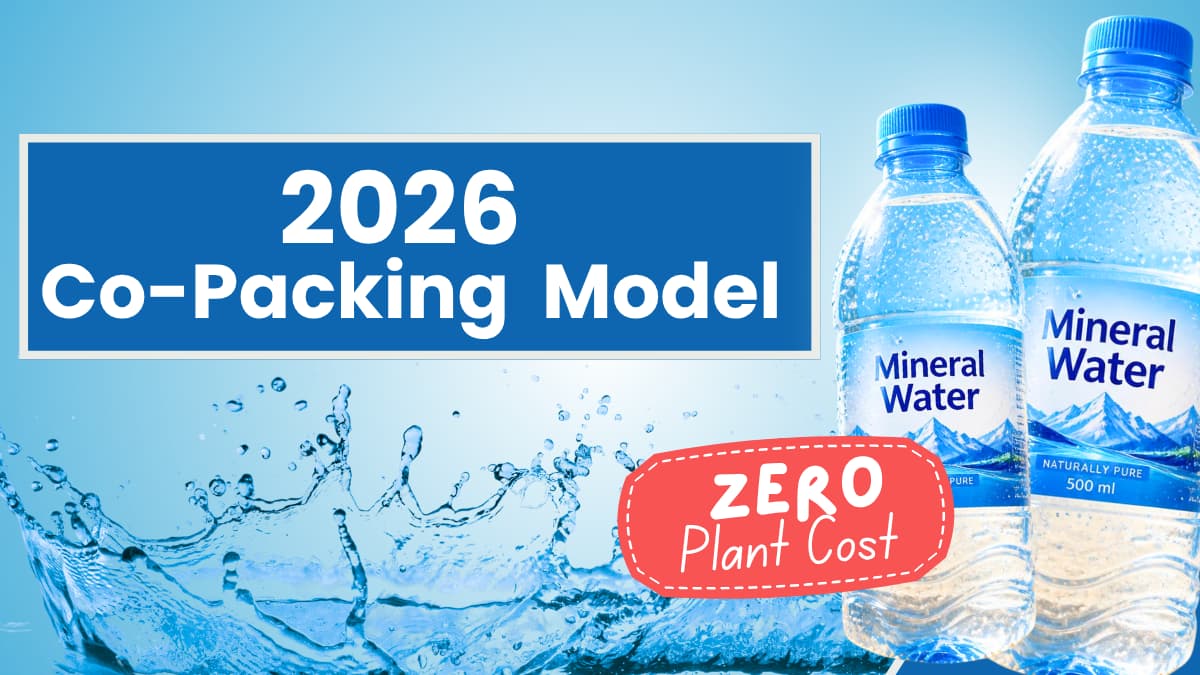
Launch Your Water Brand with Zero Plant Cost: The 2026 Co-Packing Framework

Updated March 2026 | Author Soumitra

Co-Packing is the answer to Your Water Business Dream

In the past, the massive “BIS Barrier” kept many brilliant entrepreneurs out of the water business. The requirement for heavy laboratory investment and rigid licensing meant you needed deep pockets just to start.

But the landscape has shifted. In 2026, the mandatory BIS barrier for Packaged Drinking & Natural Mineral Water has eased ( no more mandatory now 😀) allowing entrepreneurs with innovative ideas—but limited capital—to enter the market with just an FSSAI license. This creates a massive “Lean Entry” opportunity. You don’t need to own the plants & Machinery ; you just need to own the Strategy. By co-packing with traditional plant owners who already have the infrastructure, you can focus 100% of your energy on serving high-margin, emerging niches like Boutique Cafes, Luxury Showrooms, Premium Caterers, and Independent Hotels.

You bring the innovation; they provide the Water.

The Money Magnet

How to Find the Perfect Local Partner ?

Table of Contents

The 2026 Co-Packing Operating Model

Is it legal ? How the Co-Packing Model Works

The Legal Reality: Yes, this is a 100% legal and recognized business model in India. Under the current FSSAI guidelines, you operate as a “Relabeler”. You simply apply for an FSSAI license that links your brand to a licensed manufacturer’s facility. There are certain formalities, which need to be honoured like signing & uploading an agreement & NOC from the manufacturer.

Video: The 10 Foundation Pillars of Co-Packing

Editor’s Note: While the regulatory landscape for bottled water has evolved in 2026, the Core Execution Steps remain the same. Before you dive into the operational flow below, watch this detailed breakdown of the 10 “Golden Rules” for co-packing success. From managing your brand artwork to ensuring quality control in the first trial run, these 10 steps are the foundation of a sustainable business.

The 4-Step Operational Flow:

1. Finding a Local Partner (The Logistics Win)

Water is heavy, and transport kills profit. Your first task is to use the FSSAI database (as shown in my video above) to find a plant within a 50-100km radius. Look for “Traditional” plants—these are established facilities that have the infrastructure but might lack the modern branding or marketing reach that you bring to the table.

2. Deciding MOQs (Minimum Order Quantities)

Don’t let “Big Factory” numbers scare you. Since you are targeting niche markets like Cafes, Showrooms, and Caterers, you need flexibility.

  • The Strategy: Negotiate a lower MOQ by aligning your production with their existing schedule. If they are already running a batch of 1-liter bottles for their own brand, ask to “piggyback” 50 or 100 cases with your labels at the end of their run.

Special Tip :- Even if you have good funds, still start with their bottles. Don’t invest heavy in moulds, till you get convinced about the crtitical volume

3. Giving Long-Term Assurance

A plant owner wants stability, not a one-time order. To get the best technical support and pricing:

The “Commitment” Hook: Instead of a huge upfront payment, offer a Letter of Intent (LOI) or a 6-month rolling forecast possibly backed-up by a bank-guarantee. When a manufacturer knows you have a steady pipeline of orders for local Hotel Owners or Gyms, they will treat your brand with the same priority as their own.

Maximum Failed Co-Packing Deals happen not because of the Manufacturers, but failure from the entrepreneurs’ side to offer a dependable volume. Ultimately the manufacturer, with his huge investment looks for a balanced cash-flow.

4. Finding More Profitable Deals

Once you have the base model running, look for the “High-Margin” gaps:

  • Custom Packaging: Can the plant handle glass bottles for premium restaurants?
  • Proprietary Shapes: Can you provide your own unique preforms or caps to stand out? ( After meeting the Critical Volume )
  • Direct-to-Venue: By cutting out the traditional distributor and going straight to Event Managers or Boutique Showrooms, you keep the “Distributor Margin” for yourself.

The Profitable Niche Strategy (2026 Edition)

Where to Sell? High-Margin Markets for New Brands

The mistake most new water businesses make is trying to compete with “Big Brands” in retail shops. In those shops, margins are thin and competition is brutal. Instead, use your Lean Co-Packing model to serve high-value, service-oriented niches where your brand adds real prestige.

The “Target 4” High-Margin Matrix:

Market SegmentThe OpportunityWhy Co-Packing Wins
Boutique Cafes & BistrosThey want “Aesthetic” bottles that match their decor.You can offer custom labeling or unique glass bottles that big plants won’t bother with.
Luxury Car ShowroomsThey serve premium clients and hate giving out “generic” 250ml bottles.You provide a “Branded Experience” that makes their showroom look more professional.
Premium Caterers & EventsHigh-volume, one-time events (Weddings/ Corporate).You act as the flexible partner who can deliver fresh stock exactly when and where they need it.
Independent Hotel OwnersThey want to replace “Standard” brands with a “House Brand” feel.You offer them a partnership, not just a product. You manage the inventory while they focus on guests.

Why These Markets?

Traditional plant owners are often “Production Heavy”—they focus on high-volume, low-margin distribution. They don’t have the time to talk to a local Cafe Owner or a Gym Manager.

That is your gap. By using the Co-Packing model, you take the high-quality water from the traditional plant and apply your Innovative Branding to these specific segments. You aren’t just selling water; you are selling a “Premium Solution” to a business owner.

Pro-Tip : you can often command a 15-20% higher price point than standard retail water because you are providing a customized service and a better-looking product.

The Technical Audit (Don’t Sign Until You Check These)

The 15-Minute Plant Audit: Vetting Your Partner/s

Finding a manufacturer is only half the battle. You must ensure their technical standards match your brand’s promise. When you visit a local plant, here is your Engineering Checklist:

1. The “Hygienic Design” Check

  • Floor & Walls: Are the floors epoxy-coated or tiled with proper slope? Stagnant water on the floor is a red flag for bacterial growth.
  • Filling Area: Is the filling section partitioned with a “Positive Pressure” system? Dust and outside air should not enter the bottling zone.

2. The Laboratory Setup

Even though the mandatory BIS barrier has shifted for some, Quality is Non-Negotiable. * Ask to see their Internal Lab. Does it have the basic equipment for testing pH, TDS, and Micro-biological parameters?

  • Batch Records: Ask for the “Logbook” of their last 3 production runs. A disciplined plant owner keeps meticulous records; an amateur one doesn’t.
  • Check their Internal Monthly Outside Lab Reports

3. Machine Capability & “Idle Shift” Capacity

  • The Blowing Machine: Can their machine handle the specific Preform Weight you want? If you want a “sturdy” premium bottle, their machine must be able to blow a heavier preform without thinning the walls.
  • Labeling Precision: If you are targeting Luxury Showrooms, your labels must be perfectly straight. Check if they use an “Automatic Sticker Labeling” machine or if it’s manual. Manual labeling often looks unprofessional for premium niches.

4. Storage & Logistics

  • FIFO Management: How do they store finished goods? Look for “First-In, First-Out” organization. You don’t want your stock sitting in direct sunlight or a dusty corner for two weeks.
  • Loading Bay: Is there enough space for your delivery vehicle? If you are using a small tempo to serve Local Cafes, ensure the loading height matches your vehicle to avoid damage during transit.

In our Monthly Training, we have special “Resources” Session, which trains participants to design machine capacity. You can also calculate the electrical load sufficiency at the manufacturer. It is important to understand a Manufacturing Plant, even if you are not establishing the same.

Ready to Launch? Let’s Build Your Co-Packing Business.

Finding a manufacturer is a great start, but getting the Unit Economics and Technical Agreements right is what determines your profit.

If you have found a potential local plant and need a professional to:

  • Review the Technical Plant Layout.
  • Audit the Co-Packing Agreement.
  • Or calculate your ROI/Break-even for a specific niche (like Glass Bottling for Hotels).

FAQ’s

1. What exactly is co-packing in the water industry?

Co-packing is a business model where you own the brand name and marketing, but you pay a third-party manufacturer—who already has a BIS-licensed plant—to produce and bottle the water for you.

2. Is running a co-packing water business legal in India?

Yes, it is perfectly legal. However, you must follow specific regulatory formalities, including a tri-party agreement between you, the plant owner (packer), and the Bureau of Indian Standards (BIS).

3. What documents are required to start a co-packing business?

To operate legally, you typically need Udyam Registration, a registered Trademark for your brand, an appropriate FSSAI license, and a formal agreement with a licensed manufacturer.

4. How much investment is needed for a co-packing setup?

While much cheaper than building a full plant, a co-packing venture usually requires an investment of approximately ₹5–15 Lakh. This covers branding, initial stock, deposits, and operational space.

5. How long does it take to launch a co-packed water brand?

If you have already identified a BIS-licensed packer and have your resources ready, the process can be completed in as little as one month. This makes it a much faster entry point than the 6–9 months usually required for plant construction.